
What is Quantum Superposition?
It's not about the cat

I’m trying a new kind of article: physics explainers. Unlike my usual articles, these will include some mathematics but will try to explain the concept in simple terms that anyone with a high school education can understand.
In 2010, I visited Florida State University in Tallahassee. It was early spring and not too hot yet. The grass was green and the shade inviting as many students lay on the quad, reading or listening to music. My host at the university had a special treat for us as he invited us to the upper floors of the library, where we met with the archivist for one of the strangest and most famous men in the history of physics.
FSU seemed like an unlikely resting place for the papers of one of the fathers of quantum mechanics, who had spent the majority of his career at Cambridge University. There, he held the Lucasian Chair of Mathematics, the same professorship that Sir Isaac Newton had held and which, later, Stephen Hawking would hold. Yet, in his later years, he had longed for warmer climes and landed in the Florida panhandle, bringing a lifetime with him.
Paul Dirac’s books and papers were neatly arranged on shelves and in boxes within a small room with glass doors, and my fellow pilgrims, for that is what we were, were invited to rifle through them while the archivist explained what they did and how it would have been nice if Professor Dirac had put dates on more of his papers.
As I examined some random items, the archivist handed me a thin notebook. It looked like a cheap one. It wasn’t leatherbound, but the sort schoolchildren use. I opened to the first page. There, I saw written in pencil, with a neat script along the lined page, these words:
Classical mechanics has been developed continuously from the time of Newton and applied to an ever-widening range of dynamical systems, including the electromagnetic field in interaction with matter. The underlying ideas and the laws governing their application form a simple and elegant scheme, which one would be included to think could not be seriously modified without having all its attractive features spoilt. Nevertheless it has been found possible to set up a new scheme, called quantum mechanics, which is more suitable for the description of phenomena on the atomic scale and which is in some respects more elegant and satisfying than the classical scheme. This possibility is due to the changes which the new scheme involves being of a very profound character and not clashing with the features of the classical theory that make it so attractive, as a result of which all these features can be incorporated into the new scheme.
I recognized these words as the opening of Paul Dirac’s classic textbook, Principles of Quantum Mechanics, first published in 1930. (I have the 4th edition published in 1967.) These words had not changed from when he first wrote them in that, now, nearly 100-year-old notebook to this day.
Many students, however, never get very far with this subject because the mathematics and the concepts are so confusing and nonintuitive. It is hard to believe that any of them can apply to real life. Classical mechanics is all about billiard balls, rockets, and things we can see and understand. Quantum mechanics is about wavefunctions and operators as much as it is about particles. It seems more like abstract mathematics than real life.
Quantum mechanics, however, isn’t that much harder to understand than classical mechanics. It is just harder to visualize. As Dirac says, it is much more elegant too, and, if you suspend your disbelief for a moment, you too can understand it.
But why bother with this at all? Why do we need quantum mechanics?
We need quantum mechanics because, without it, we could not explain why matter exists at all. A classical atom or molecule, modeled like a little solar system with electrons zipping around a nucleus, would be inherently unstable. It is because atoms are more digital and less analog that we can exist.
Even on philosophical grounds, quantum mechanics is necessary. In classical physics, size is always relative. Something is big only in comparison to something smaller. There is no concept of absolute size. If you were to shrink yourself down smaller and smaller, insects would suddenly become big, then cells, then molecules, and then atoms. Yet you could go further to subatomic particles and so on. This would mean that a classical particle must be big relative to something. And logically, that something must therefore exist. This goes on ad infinitum.
Quantum mechanics, however, introduces the notion of something that is absolutely small. This arises because the means by which we observe anything requires some disturbance to that thing. To observe an ant, we must recognize light scattering off it. The ant is large compared to the light. Therefore, the light makes little disturbance. The same is true for cells. Yet, once we approach the size of molecules, and certainly atoms, light that is sufficiently intense to see them would cause them to shoot away as if shot by a cannonball. We have to use lower power, small wavelength objects like electrons, which is why electron microscopes are a thing, for molecules. Going smaller, there is a finite limit to what is achievable. This is what makes smallness absolute. This is not simply an engineering limit on our abilities but a physical law, a transition from the classical to the quantum encoded by Heisenberg’s uncertainty principle.
While philosophy demands that something like quantum mechanics exist, quantum mechanics also makes demands on philosophy. It tells us that causality, as we know it, is flawed. We can no longer propose observing a closed system evolving as we can in classical physics because our act of observing a small system violates the closed assumption. We can describe undisturbed systems evolving in quantum mechanics, but those equations only relate probabilistically to what we actually observe. Quantum mechanics itself fails to account for how observation affects things.
Perhaps one of the most startling aspects of quantum mechanics is the superposition of states, which can be a feature of undisturbed systems. This is the background for the famous Schroedinger’s cat thought experiment, but the thought experiment itself tends to obfuscate the phenomenon. This principle is fundamental to quantum theory but can be confusing in the general case. Let’s look at a simple case of light polarization.
Did you know that sunglasses use a quantum phenomenon to shade your eyes?
Sunglasses are polarized, which means that they only let light through that lines up with the direction of polarization. There are three kinds of polarization: vertical, horizontal, and circular.
These terms, however, are misleading.
Imagine that you and a friend are holding a rope between the two of you, and one of you starts jiggling their end up and down. Waves, which are aligned in the vertical direction, start to travel along the rope. Likewise, I could do the same in the horizontal direction (ignore gravity for the moment).
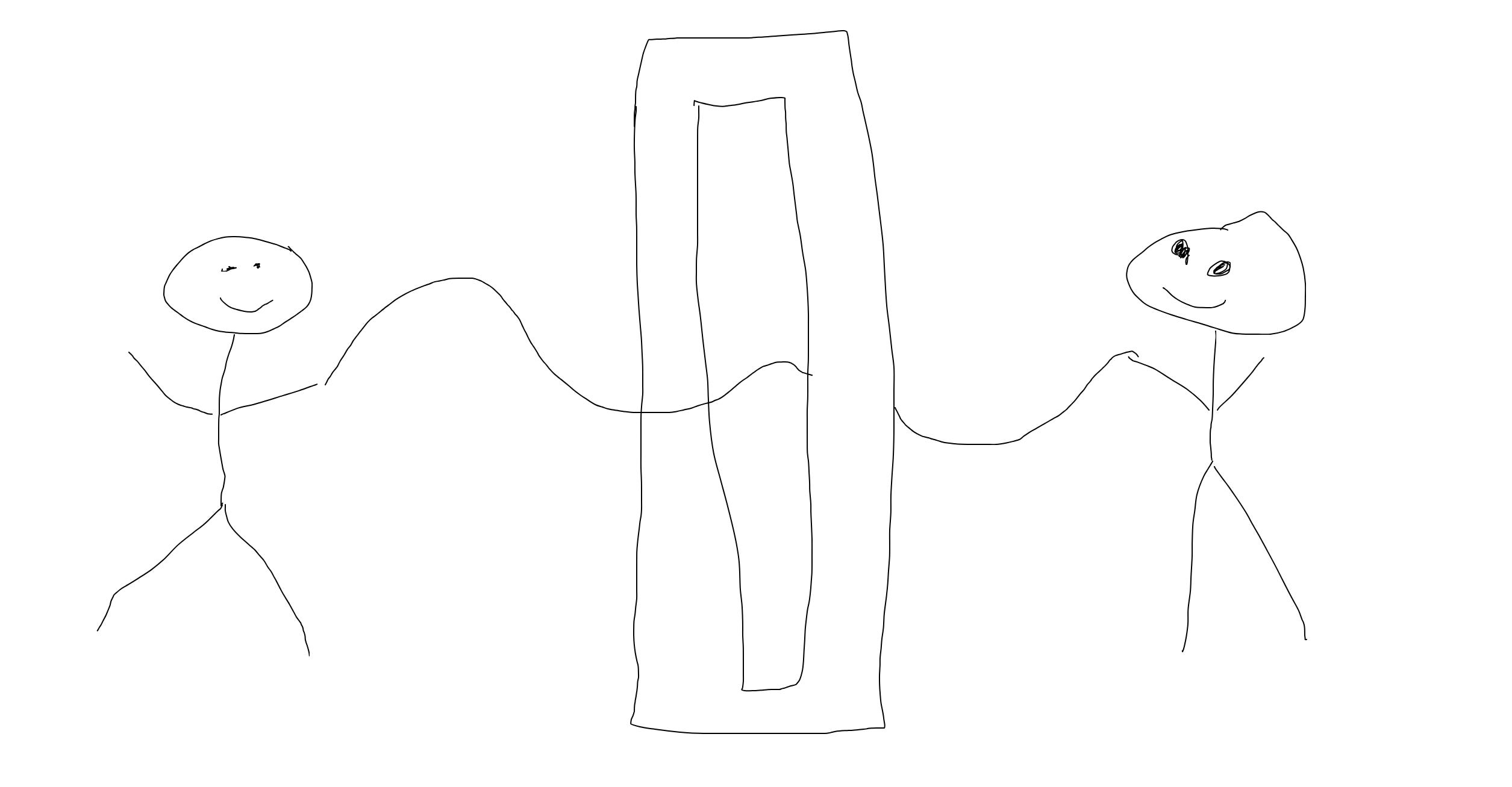
Suppose you stop and thread the rope through a barrier with a long vertical slit cut into it. Now, if you start jiggling the rope up and down, the waves pass easily through the slit. If, however, you try jiggling the rope side to side, the waves crash into the barrier, dissipating against it.
I could reverse things and use a horizontal slit, and then the vertical waves could not pass through.
Circular polarization is a bit more complicated, but I imagine we could achieve something similar for that as well.
This is a nice picture of how polarization works, but it is about as accurate as the image of an atom as a mini-solar system. It doesn’t take quantum into account.
Consider that if I cut a diagonal slit into the barrier, neither my vertical nor my horizontal waves could pass through at all. In fact, classical physics tells me that I don’t have three polarizations at all, but an infinite number depending on the angle.
Not so with quantum mechanics.
If I produce some randomly polarized light and pass it through a polarizing filter, such as sunglasses, guess how much will be able to pass through?
If it were like the rope, then we might guess a very small fraction would happen to be polarized in a way that it could pass through.
The real answer, however, is half.
Fully half will randomly select to pass through.
After passing through, moreover, all the light coming through the other side will be polarized in alignment with the filter.
If I place some similar sunglasses behind the first ones but at a right angle, all the light will be blocked out.
As I turn the second set of sunglasses, however, I will see the amount passing through increase according to a formula that is the cosine squared of the angle between the two sunglasses.
If light were only a wave, we might imagine that this makes some sort of sense, but now we recall that light must also be a particle, called a photon.
We know that light is made of photons for many different reasons. One is called the photoelectric effect, which is where, by shining light onto certain kinds of atoms, they emit light particles at a precise frequency. It was this phenomenon that got Albert Einstein the Nobel Prize (not relativity).
Each photon itself has a state of polarization.
How can we then account for the behavior of photons passing through the polarization filter? If each photon has a particle polarization, then surely only those that line up with the filter should pass through, not some weird fraction.
To understand this better, let us therefore set up an experiment where we send only one already polarized photon at a time through the second polarizing filter.
What will happen is that we will never measure a fraction of a photon passing through the filter. Instead, we will either measure a whole photon coming out or none at all. If we send many through, one at a time, we will find the probability that a photon passes through is equal to the cosine squared of the angle.
This experiment doesn’t tell us anything about how the photon decides whether to pass through or not, and, indeed, quantum mechanics cannot tell us that either. Quantum theory, however, can tell us how to interpret the state of the photon before passing through the second filter.
The photon is in a state of superposition when it encounters the second filter placed at an angle to the first, where it is partly vertically polarized with respect to the second filter and partly horizontally polarized.
This is possible in classical physics if you have a wave, but not with a particle. Quantum mechanics allows it to be applied to a single photon.
When the photon meets the filter, the filter performs an observation because it only allows photons with vertical polarization through. Because it is an observation, it forces the photon to choose one of its states in superposition, and the other must vanish.
Although the choice that is made cannot be predicted, the photon, nevertheless, makes it and jumps to one or the other. If the result is vertical, it passes through. If horizontal, it does not.
Here is a diagram of how this works.
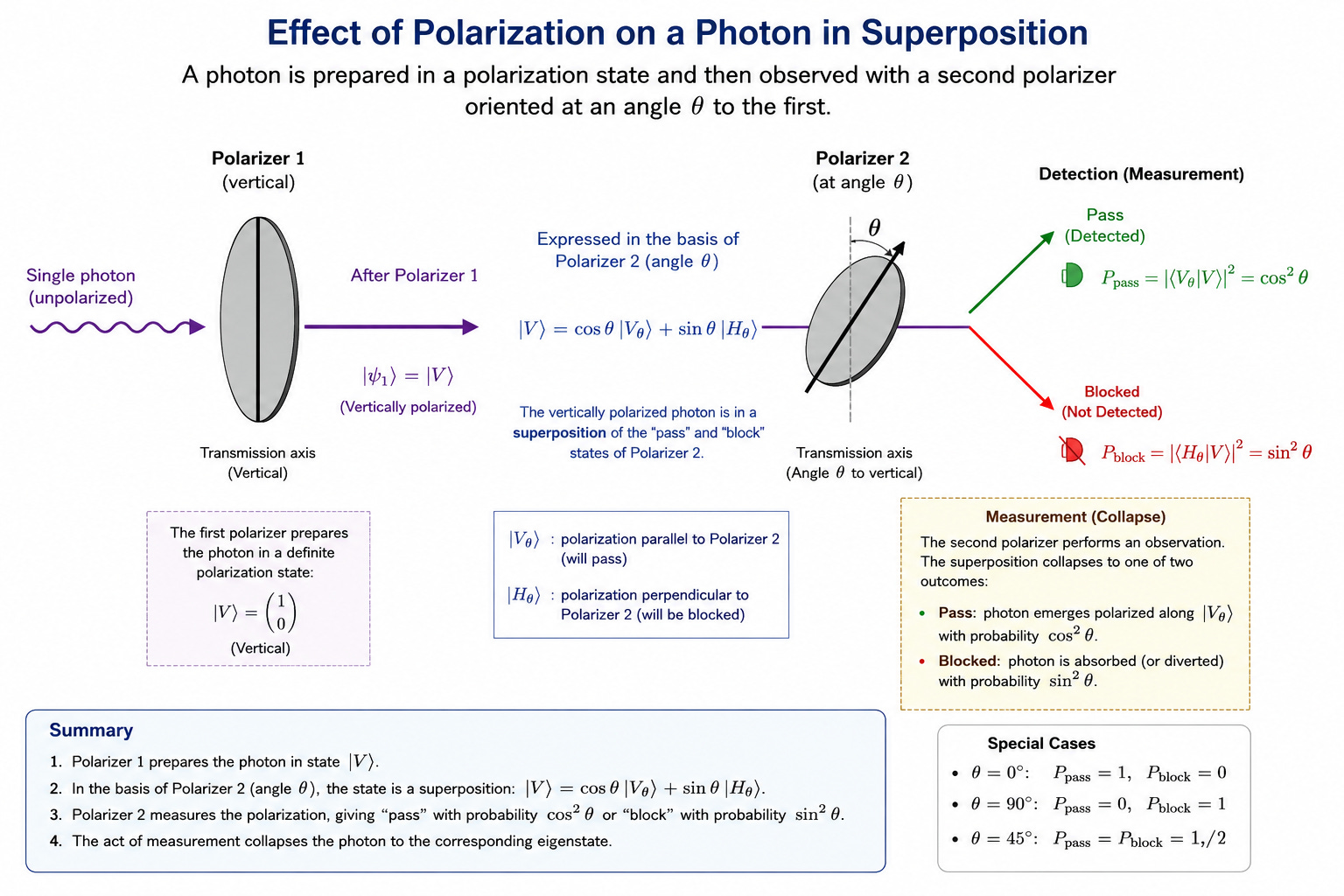
The first polarizer vertically polarizes the photon, but that is only in the basis of that polarizer. These are in purple above. A basis is like a coordinate system, but for quantum states. We can shift the basis to that of the second polarizer, which rotates the polarization so that now it is partly vertical and partly horizontal. This is in blue. In the basis of the second polarizer, it is a superposition of “pass” which means the polarization of the photon will jump to match that of the polarizer, and “block,” which means it will jump to be perpendicular.
The photon will pass through the second polarizer with a probability that is the cosine squared of the angle. This is because probabilities in quantum physics are computed by squaring them. In the “pass” case, the original superposition state is projected onto the vertical polarization state and squared. This is in green.
To project a state onto another state is like shining a light on the first state. It is a silhouette or shadow of the original state. The same thing happens when the sun projects your shadow onto the ground. The two-dimensional cutout of your body is projected onto the ground.
The “blocked” state probability is the square of the projection of the original state onto the horizontal polarization state in the basis of the second polarizer. It is equal to the sine squared of the angle. This is in red.
The diagram uses a notation invented by Dirac called bra-ket notation. This is a bra:
And this is a ket
The symbol inside can be anything you want. It is just a symbol to help you keep track of what the bra and ket refer to.
You can combine bra’s and ket’s like this
These are kind of like vectors if you are familiar with those, with the bras being like row vectors and the kets being like column vectors, but the easiest way to think about it is that these are quantum states. To combine two quantum states to get a single number, you have to combine a bra with a ket in that order. If you combine a ket with a bra, you get something called a density matrix, but that is way beyond the scope of this article.
Because this applies to a single photon, the polarization is not an emergent phenomenon from many particles waving together. Rather, it is inherent to the photon, like a bit of information about it. In fact, it is a quantum bit or qubit.
Quantum superposition is sometimes described as the particle being in both states at the same time, as if the cat were alive and dead at the same time in the thought experiment. That is not a good way to describe it.
For one thing, a quantum superposition is a pure quantum state, meaning that it is a single state, not two states at once. It is only our classical intuition that makes us want to interpret it that way.
A better way to look at it might be something like a position on a sphere. The cosine and sine lend themselves easily to spherical coordinates. Classical information only includes states that are at the North or South Pole of the sphere, but quantum physics can wander anywhere on the sphere. We have a new sphere for every qubit of information.
When we make a measurement, however, the state snaps to the North or South pole, and we can never observe it anywhere else.
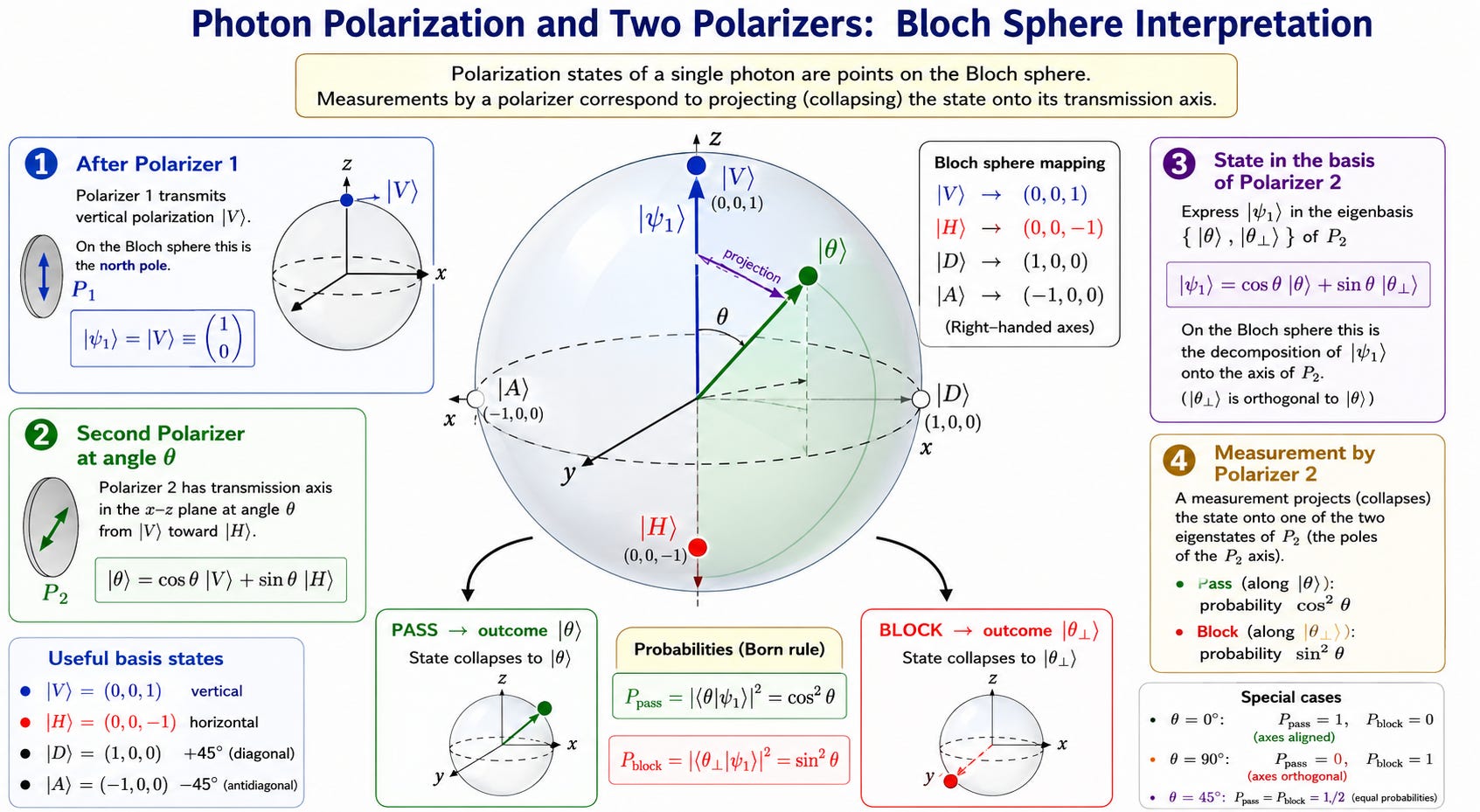
A change of basis is like rotating the sphere so the North and South poles are somewhere else.
So, you can see in the diagram that after the first polarizer (blue box in the upper left), the state is simply at the North Pole in the basis of that polarizer.
The second polarizer, however, is in a different basis. The green box on the left side shows where the vertical polarization of the second polarizer is in terms of the polarizations of the first polarizer. In other words, we have to express the angle between the two polarizers, not as a number but as a ket, so we can use it in the next step.
The original state of the photon can be expressed in the basis of Polarizer 2 as a combination of the angle and its perpendicular, both as kets. This is the purple box on the upper right side. The ket
refers to the state corresponding to the vertical or “pass” polarization of the second polarizer, the green line on the small sphere at the bottom left. The ket
corresponds to its perpendicular or “block” polarization, the red line on the small sphere at the bottom right.
The original state is expressed as a superposition of these two states. The states are weighted by cosine and sine.
The measurement by the polarizer, which passes or blocks the photon, snaps the photon’s state to a position on the sphere corresponding to the green line (pass) or the perpendicular (block), which points to the opposite side of the sphere. These are the North and South poles in the second polarizer’s basis.
While an ordinary classical bit of information has only two values, a quantum bit of information can range anywhere over the sphere. It is only when a measurement is made that it snaps to one of two possible values, which correspond to a North and South pole in the relevant basis (but not all bases). Superposition is, therefore, precisely the state that is on neither the North nor the South Pole in the relevant basis.
From this perspective, superposition is obvious. It is not somehow in the state of the North Pole and the South Pole at the same time, any more than the location of New York City is a combination of the North and South Poles on Earth. It is a single location at neither pole. Yet, it is a location that cannot survive observation; it is only in the post-analysis that we interpret it as being both states at once. It is only one state, but we cannot observe it. Nature hides superposition from us, and we don’t know why.