
Was Feynman wrong about quantum mechanics?

About two years ago, I wrote an article on a preprint by a pair of MIT researchers, Lohmiller and Slotine, who claimed to have reproduced quantum mechanics using classical mechanics. Recently, that paper was finally published in a peer-reviewed journal.
The authors claim to reproduce quantum mechanics by allowing branching behavior in classical mechanics, having different classical timelines overlapping and interacting. These branches can still interfere with one another, so the idea is that you don’t need all these crazy zigzag paths that Richard Feynman’s approach requires.
Feynman’s approach is called the path integral because it involves integrating, meaning summing, the quantum phases over all the different paths leading up to a measured particle’s state.
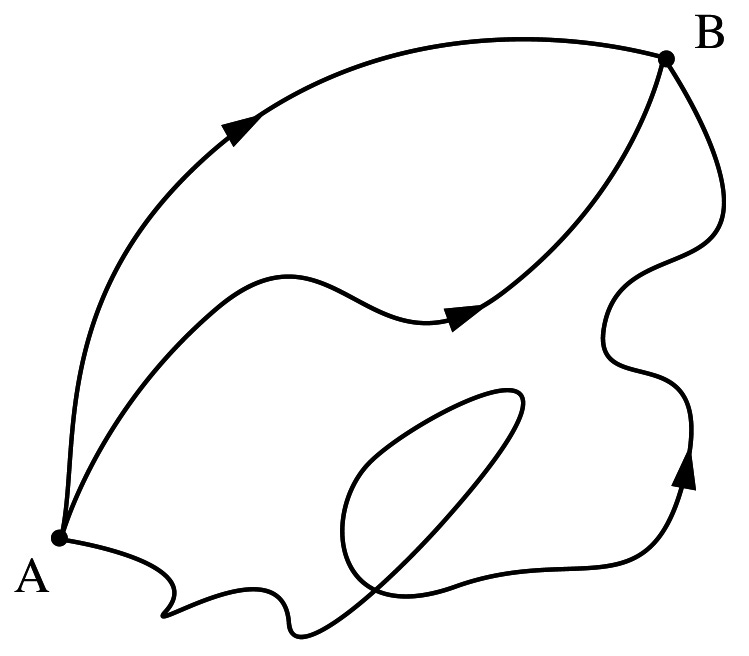
The path integral sums over every path in the universe, meaning that it includes paths that zigzag out to Alpha Centauri, the Andromeda Galaxy, and so on and back to the lab in even the tiniest experiment. Such long paths contribute very little to the integral, but they are there. It would be nice, therefore, if someone could come up with a more intuitive approach where particles follow paths that make more sense.
These guys claim to have achieved exactly that.
In classical mechanics, all trajectories obey something called the principle of least action. This means that there is a function called the action that, when minimized, determines the path an object will take.
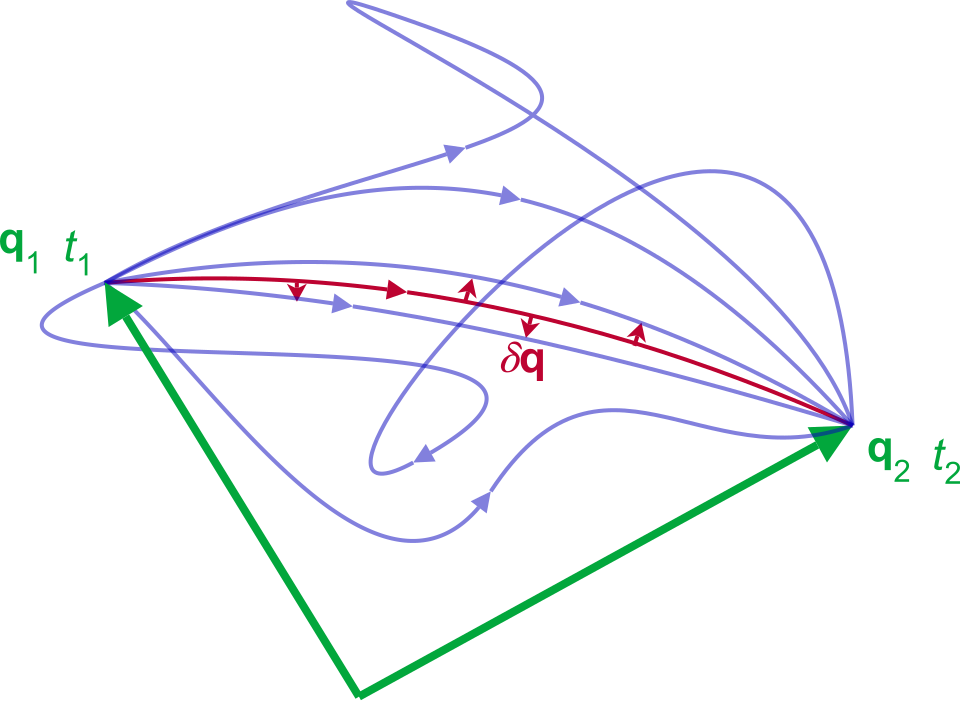
Most paths in the path integral violate the principle of least action because their actions exceed the minimal action, like the purple paths in the above image. Those that are minimal, meaning classical paths, contribute the most to the integral, but they are not the only ones.
The authors claim to have done away with Feynman’s extra paths and kept only the minimal necessary set to reproduce quantum mechanics. All of these turn out to be classical paths.
They point out that classical mechanics has branching paths just like quantum mechanics. For example, if you want to know the classical path of a ball from point A to point B, normally there is only one path, but if there are barriers where the ball can bounce or pass through holes, then there will be more than one path that minimizes the action. You can also vary the initial conditions to get different paths as well, something the authors make heavy use of.
The famous double slit experiment is an example of such a multi-path system. There are two classical paths. If they can interfere with one another like waves, then the standard interference pattern will result.
Unfortunately, L&S made a fatal mistake.
Reading the paper, you get the impression that the authors do not normally work in quantum mechanics. The notation is more typical of classical nonlinear dynamics. I’ve worked in both fields, so I recognize this as being more in the language of the applied mathematics/control theory community than physics. This might explain why they run into problems. Looking at their publication history, they have published mainly in nonlinear systems, a fascinating but classical area of physics. They also appear to be mechanical engineers. Engineers are notorious for stumbling into fields they know nothing about and acting like everything is a design issue.
L&S, through a series of mathematical lemmas and a theorem, show that they can reduce the quantum Schrodinger’s equation to the classical Hamilton-Jacobi equation. This is a red flag. (Also, when I wrote my first article about their work, they hadn’t yet made this assumption, although they were getting close.)
The assumption isn’t wrong; it is just a special case. The Hamilton-Jacobi equation is a classical equation that connects classical mechanics to wave mechanics, so it is a natural choice. David Bohm used insights from the Hamilton-Jacobi equation in his Bohmian mechanics in the 1950s. And Edward Nelson used it to derive his stochastic quantum mechanics. Neither of them, however, just assumed that you could get quantum mechanics from the classical equation.
Something extra appears when you transform the Schrodinger equation into the Hamilton-Jacobi equation (using something called the Madelung transform), called the quantum potential, Q. This potential is proportional to the spatial variation of the density of the quantum wavefunction. The equivalence is sometimes called the (Madelung) hydrodynamic form of quantum mechanics. The equations really resemble those of some kind of fluid with a density and a velocity field.
The density variations present in Q are exactly what allow all those crazy zigzag paths in the path integral. It frees reality to deviate from classical mechanics. L&S assume that, along their multi-branching trajectories, the quantum potential is zero, which throws all those crazy paths out from the get-go. This is like assuming your fluid always has constant density. That may cover a lot of fluids, but not all fluids in the universe.
So, they did not show that they can reproduce quantum mechanics from classical branching; they eliminated all quantum mechanics that doesn’t conform to classical branching. It is circular reasoning.
They do manage, however, to demonstrate their model reproduces the wavefunctions for several standard examples, including the double slit. They achieve this in two ways: for some models, like their particle in a box example, the quantum potential is zero anyway. For others, like the quantum harmonic oscillator, they just smuggle it in through their initial conditions, which is clever but makes little sense.
Sabine Hossenfelder refers to this paper as “bullsh*t” on her YouTube channel, and indeed, a detailed takedown of the paper’s main conclusions by Gábor Vattay has appeared on arxiv (it has not been peer reviewed yet). Too bad the peer reviewers didn’t catch this, or, as Hossenfelder suggested, the authors didn’t give ChatGPT/Claude/Grok a pass over it.
To be honest, I’m not sure if the paper is completely useless. It isn’t strictly semi-classical but more of a hybrid. It might have some computational utility in some cases, but it says absolutely nothing about reality other than you can get almost anything published in a peer-reviewed journal these days. I’m not sure I’d want to have a paper become infamous like this even for a few weeks.
After I wrote my last article on the earlier preprint, I did go through the paper in more detail since, at the time, I was working on Hamilton-Jacobi approaches to quantum mechanics. I found it contained some unvalidated assumptions, although it had yet to set the quantum potential to zero, and at the time correctly recognized that it would not be zero for some examples. Strange how it got worse before it was published.
Honestly, my conclusion from spending a few months on the subject is that the HJ equation almost always makes quantum mechanics more complicated than it needs to be. It introduces nonlinearities where Schrodinger has none, and once you start introducing many-bodied dynamics or field theory, the connection to classical hydrodynamics disappears as you end up in higher and higher dimensions, becoming infinite-dimensional with field theory.
Worse, there is an inherent problem when going from Schrodinger to the hydrodynamic form (even if you do it correctly) because Schrodinger’s equation has a symmetry that disappears in the conversion. This is why Nelson’s stochastic quantum mechanics has problems since it depends on stochastic paths that obey the hydrodynamic form.
To understand this problem, imagine you have a particle confined to a one-dimensional ring. In standard quantum mechanics, the wavefunction defined on the ring is periodic, meaning it wraps back around since the ring is a circle. This forces the wavefunction to take on only states that have phases that are integer multiples, so that they all obey the same periodic structure.
Think of it like this. I have a bunch of cars driving around a circular track. For all the cars to cross the finish line on each lap at the same time, they have to be traveling at speeds that are integer multiples of one another, so the first car is just sitting stationary at the finish line, the second car is going around at speed s, the third car at speed 2s, and so on. You even have cars traveling the opposite direction -s, -2s, -3s, and so on. Perhaps this is because the cars are being refueled by some giant cross arm that comes down at a certain rate 1/s. In any case, the cars are synchronized.
This is the kind of restriction enforced on the wavefunction’s states.
When you go to a hydrodynamic form, this restriction disappears from the equations. Suddenly, the cars can go any speed they want and cross the finish line whenever they want. Unless you add it back in artificially, therefore, the hydrodynamic equations are not equivalent to Schrodinger’s because that rule, which is a symmetry, breaks.
Therefore, even though L&S could account for the quantum potential by adding stochastic (random) zigzags to their branching paths, as Nelson does, and that might be an interesting variation, their model would still have a serious issue. Even if L&S managed to get their model to account for the quantum potential correctly, their approach would still fall short of a full quantum theory for the same reason why Nelson’s does. The HJ approach to quantum mechanics just doesn’t work.