
Was Einstein wrong about relativity?
How general relativity is anything but

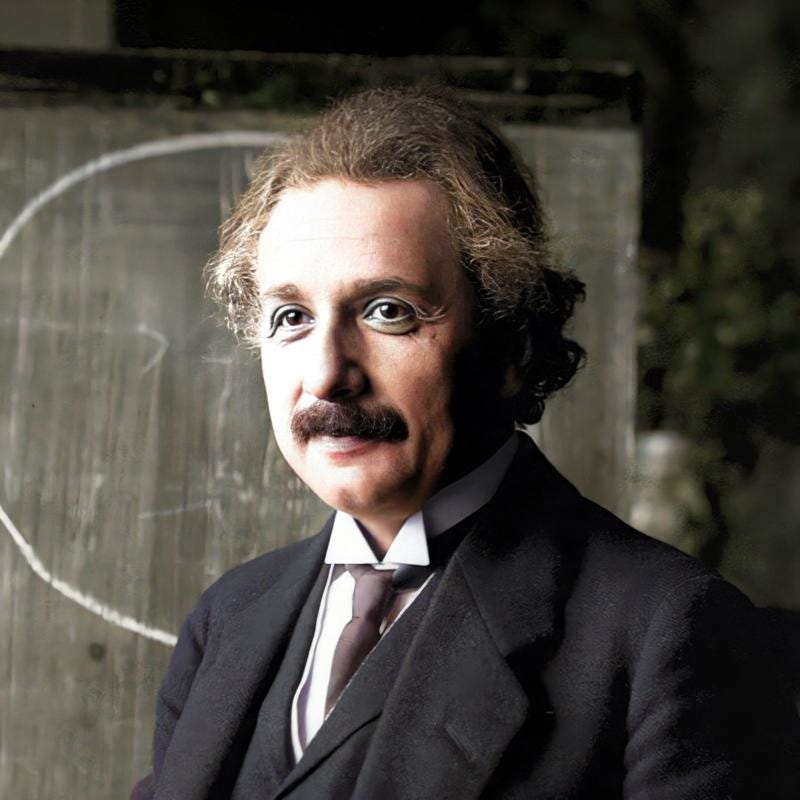
Albert Einstein is one of the most famous scientists in the history of science. He not only completely changed our understanding of motion and gravity with his theory of relativity, upending 300 years of Newtonian physics, but he also contributed substantially to the quantum revolution. He is responsible for perhaps one of the most famous equations in the world, ee equals em cee squared, which equates energy with mass. His iconic look, meanwhile, with long white hair and a droopy mustache, combined with a German accent, has become the de facto image of a scientist in the modern world.
His theory of relativity has stood the test of time, having been confirmed numerous times with rigorous tests.
But what if I told you that the theory that we know today as Einstein’s General Theory of Relativity is not the theory Einstein was even looking for, and that, although his ideas evolved over his lifetime, he never came to the consensus that most physicists hold today? Moreover, although Newtonian physics and even Einstein’s special theory of relativity contain relativist concepts of observer dependence, so-called general relativity does not, in fact, contain any nontrivial relativity at all. And that may be a big problem.
Einstein was born in 1879 at a time when physicists largely believed physics to be a solved problem. They had Newton’s theory of forces and motion, as well as Maxwell’s theory that explained electromagnetism. There were still some tricky questions about the physics of systems of many particles, like fluids and gases, but the underlying physics was thought to be well-known.
Some discrepancies remained in well-established physics: for example, the orbit of Mercury deviated very slightly from Newton’s prediction.
Also, it was not known how electromagnetic waves propagated through empty space. It was thought that some kind of substance called a luminiferous ether must be responsible. Michelson and Morley, two Americans, attempted to measure the Earth’s motion through this ether by measuring the speed of light in the direction of the orbit and perpendicular to it. They showed no difference.
Einstein seemed an unlikely candidate to change all this. He was a lazy student, and although he excelled in physics and mathematics, he spent two years failing to gain a teaching position in those subjects. Einstein worked in a Swiss patent office, a position he only gained through the help of his friend’s father. He spent a great deal of his time, however, thinking about physics and working out theories about space, time, and matter.
He was deeply engaged with the philosophy of the time. This both helped him in his goals but also hindered him in his ability to understand and embrace the implications of the scientific revolutions he helped initiate.
Einstein was a follower of Ernst Mach, who, besides being known for measuring the speed of sound, formulated Mach’s Principle, which is that all motion is relative to the motion of other objects, including rotation. (“Mach’s Principle” was, in fact, coined by Einstein himself.)
Mach formulated the principle in response to a thought experiment Sir Isaac Newton had introduced, called the bucket argument.
The idea is that if you have a bucket of water on a rope and you spin it, at first, the water sits there while the pail rotates. After a while, however, the water also begins to rotate, and a depression will appear in the surface of the water as the water is pushed to the outer rim of the bucket away from the center. If you are watching the bucket spin, this makes perfect sense, but what if you are somehow sitting on the bucket?
In this case, you should know you are rotating because everything else is spinning around you, including the distant stars. But what if you are in an empty universe with no other matter?
The surface of the water will still be concave, Newton argues, and therefore motion cannot be entirely relative but must be absolute.
Mach came along and argued,
Newton's experiment with the rotating vessel of water simply informs us that the relative rotation of the water with respect to the sides of the vessel produces no noticeable centrifugal forces, but that such forces are produced by its relative rotations with respect to the mass of the earth and other celestial bodies. - Ernst Mach, as quoted by L. Bouquiaux in Leibniz, p. 104
In other words, the motion of the water is still relative to all the matter in the universe.
Einstein strongly agreed, and when he published his special theory of relativity at age 26, he demonstrated how this principle would affect the way different observers measure space and time.
He later attempted to drag this idea into his general theory of relativity, which would address the bucket argument properly. This general theory explained not only accelerating and rotating motion but also gravity, and it is what we still use today.
In a talk at Princeton in 1921, after he became famous for this theory thanks to measured light bending around the sun in 1919, he claimed (as he never did in writing),
Whenever we talk about the motion of a body, we always mean by the very concept of motion relative motion…we might as well say ‘the street moves with respect to the car’ as ‘the car moves with respect to the street’ … These conditions are really quite trivial … we can only conceive of motion as relative motion … All this goes without saying and does not need any further discussion. - Quoted by Michel Janssen.
Far from being trivial, however, these points are not even true.
Einstein had a habit of clinging to his earlier philosophical beliefs, it seems, with the public, even when he had conceded them academically. By 1918, Einstein had already accepted the defeat of relativity at the hands of Erich Kretschmann. His own theory did not support his claim that all motion is relative.
The phrase “general relativity” is, in fact, one of those historical oddities in that its name implies something that the theory to which it refers lacks.
Einstein had believed, up until 1918, that general covariance was a property of his theory that made it generally relativistic. General covariance, however, is only the ability to express a theory in any coordinate system (or none at all). Thus, I am free to choose my coordinate systems to be anything, even something ridiculous. Because the equations are expressed in a generally covariant way, this is physically equivalent to saying that the laws of physics are the same for all observers.
In 1917, Erich Kretschmann, a former student of Max Planck and a high school teacher, attacked Einstein’s claims about his theory. In particular, Kretschmann showed that just about any space-time theory could be made generally covariant, and, indeed, by 1923, Newton’s theory was made generally covariant.
While general covariance says that all observers experience the same physical laws, it doesn’t say what those laws are.
In what sense, therefore, is GR generally relativistic?
Einstein argued that his theory was generally relativistic because it had these three elements:
General covariance - all observers have the same physical laws.
Mach’s Principle - motion of matter is relative to the motion of other matter, with their gravitational fields being the mediator between them.
Equivalence Principle - a gravitational field is indistinguishable from accelerated motion.
With great difficulty, Einstein produced, in November 1915, several short papers containing his field equations, and the next year published a review paper laying the entire theory out as well as its implications, including corrections that explained Mercury’s orbit and light bending around the Sun.
Einstein believed he had succeeded.
This turned out to be an illusion.
His theory did not meet condition #2 above. It did not guarantee that all gravitational fields have material sources, and therefore, matter could have motion that has nothing to do with the motion of other matter.
In 1917, he decided to add a cosmological constant to his theory. Many popular science communicators claim this is because Einstein was attached to the idea of a steady-state universe and needed the constant to stop the universe from changing density. That is true, and, if you just read his paper on the topic, you might conclude that is all he’s after, but the reason why he wanted a static universe in the first place isn’t obvious. Many popularizers erroneously conclude that it is because he was stuck in an old philosophical school that wants to have an eternal universe with no beginning.
But that isn’t why: it was, in fact, a flailing attempt to prop up Mach’s Principle.
He wanted a universe that firmly held onto its matter so that it could not become empty.
Almost immediately, however, Dutch physicist Willem de Sitter discovered that you could have an empty universe with a cosmological constant.
Einstein accused him, saying, “You have violated Mach’s principle.”
Thanks to de Sitter, Einstein, however, realized that his cosmological constant could not rescue the principle.
Absolute motion was here to stay, and absoluteness is built into general relativity.
To see why, take a simple example: suppose you have two observers, Alice and Bob, moving in non-uniform motion with respect to one another. Is Alice, Bob, or both moving non-uniformly? If you can answer that question within Einstein’s theory, then Mach’s Principle fails.
Assume a flat spacetime and let Alice be in inertial motion. Bob is experiencing a constant acceleration a.
GR can tell us which one is inertial and which one is accelerated, regardless of the reference frame. Because Alice is in what is called geodesic motion, meaning free fall, and Bob is not, their motion, independently of one another, satisfy different equations. Alice satisfies the geodesic equation. Bob does not.
Physically, each one can carry an accelerometer and determine if they are accelerating regardless of their relative motion, even in a totally empty universe.
GR also shows that Mach is wrong about Newton’s bucket. There is such a thing as absolute rotation, as Newton said, and Einstein’s equations show that and exactly why it is absolute.
Thus, some motion is relative but not all motion. What motion is relative? Straight line, uniform motion.
Two principles down: general covariance is not unique to general relativity and Mach’s Principle fails, but what about the third, the equivalence principle?
Without the other two, this principle alone cannot guarantee relativity.
For this to be true, you would have to be able to attribute any acceleration or non-uniform motion to a gravitational field, and Einstein believed he could prove this.
In 1907, Einstein came up with the thought experiment of a person in an elevator. This person cannot distinguish between acceleration caused by the motion of the elevator and that caused by a gravitational field, he thought. Five years later, he gave the name “equivalence principle” to this idea.
Einstein hoped that this would allow a theory of relativity for non-uniform motion, but it was doomed to fail. If Einstein were correct, then you could have situations like this: Suppose Alice is on an airplane, enjoying nice, smooth motion. She can claim, because her motion is uniform, either that she is moving or that the ground is moving. That is special relativity (or Galilean relativity). Now, a sudden jolt happens, and her drink spills.
Can she claim that a random passing gravitational field caused her drink to spill?
No, she can’t. To do so is to violate general relativity itself. A gravitational field is not just an acceleration. It must produce tidal forces, affect nearby objects, curve spacetime, and change the motion of other freely falling bodies. It cannot simply explain the spill of one drink.
With general relativity, all that relative motion is now a special case. General solutions and states of motion in Einstein’s universe are not relative but absolute.
This explains, for example, why the twins paradox exists. In this paradox, two twins, sometimes named Peter and Paul, start out on Earth, and one takes off in a spaceship, travels near the speed of light for several years, turns around, and comes back. Now the twin that left is younger than the twin that stayed behind.
Richard Feynman put it this way:
This is called a “paradox” only by the people who believe that the principle of relativity means that all motion is relative; they say, “Heh, heh, heh, from the point of view of Paul, can’t we say that Peter was moving and should therefore appear to age more slowly? By symmetry, the only possible result is that both should be the same age when they meet.” But in order for them to come back together and make the comparison, Paul must either stop at the end of the trip and make a comparison of clocks or, more simply, he has to come back, and the one who comes back must be the man who was moving, and he knows this, because he had to turn around. When he turned around, all kinds of unusual things happened in his space ship—the rockets went off, things jammed up against one wall, and so on—while Peter felt nothing.
So the way to state the rule is to say that the man who has felt the accelerations, who has seen things fall against the walls, and so on, is the one who would be the younger; that is the difference between them in an “absolute” sense, and it is certainly correct.
Both of these cases, Alice on the airplane and Peter and Paul, are examples of absolute motion and violate the equivalence principle Einstein hoped to introduce.
The principle Einstein hoped for would read something like:
Every acceleration can be explained as a relative motion within an arbitrary gravitational field.
But that is not true. The equivalence principle allows some gravitational effects to be locally mimicked by acceleration.
Modern physicists use a different definition altogether:
Any free-falling observer has a locally flat reference frame.
In other words, if Alice is in orbit, in free fall, she can claim (approximately) that her own reference frame is a flat, special relativistic frame, no matter what gravity she is experiencing. It says little about acceleration. This is a far cry from what Einstein was after with his thought experiment.
Einstein was forced to abandon this hope as well.
Thus, all three of the principles that Einstein hoped his theory was built upon in 1915-16 were torn down in short order, such that, by 1920, he ought to have been singing a different tune, but still seemed to cling to his earlier philosophy despite Kretschmann, de Sitter, and others systematically disillusioning him.
Kretschmann went as far as to say,
Einstein’s theory physically satisfies no relativity principle whatsoever…; it is a completely absolute theory in regard to its content.
You might even call general relativity, general absoluteness.
In fact, special relativity is far more relativistic than general.
Despite this, there are still questions about whether the theory of gravity itself contains more relativity than these early pioneers found in Einstein’s theory.
Could GR be overly restrictive?
In special relativity, there actually are different reference frames. They have different physical experiences, but their measurements can be related by certain mappings called Lorentz transformations.
You will often hear people argue that general relativity has diffeomorphic invariance. This is the modern belief system. This means that solutions to Einstein’s equations that can be related to one another by a differentiable mapping are physically equivalent.
Diffeomorphic invariance, however, is not a true physical symmetry, unlike the invariance under Lorentz transformations in special relativity. Rather, it means that there is redundancy in the mathematical representation of the theory.
Yet, GR is really about how motion couples to geometry. Its central field is called the metric tensor, but it can also be called an inertio-gravitational field. Thus, it combines both motion and gravity.
The question is: does the inertio-gravitational field represent a unique reality, or can visibly distinct examples represent physically equivalent realities?
Take an example: suppose you have two gravitational fields that give the same free-fall trajectories. If all you measure is inertial motion, then you can’t distinguish the two fields. If inertial motion is what matters, then all the fields that represent the same set of free-fall trajectories represent the same reality.
Alternatively, you can apply conformal mappings to the gravitational field, where you stretch or compress the metric field by a different amount at each point at the same time. Basically, it means that the volume of spacetime at any given point is irrelevant to physics. All that matters is the causal structure. Under those transformations, light propagation is unchanged. This determines the causal structure of the universe.
This would mean that all inertio-gravitational fields that have the same causal structure but different volumes represent the same physical reality.
What is physically meaningful?
Is it diffeomorphic invariance? Free-fall paths? Causality?
There is an old program from the 1970s that attempted to reconstruct spacetime geometry from the behavior of particles and light. This is the precursor to quantum gravity approaches such as Causal Set Theory, which is based on the causal structure of spacetime. CST argues that conformal mappings don’t change the fundamental causal structure of spacetime and therefore aren’t physically measurable. As long as you know the causal structure, you know just about everything. Several other theories, including Causal Dynamical Triangulation (CDT) and Twistor Theory, use the same idea.
Philosophically, it bears thinking about that Einstein started with some very wrong ideas but came out with the right theory. Nevertheless, we have only just scratched the surface of what is really fundamental to that theory. What he considered to be fundamental, many researchers in the field consider to be emergent. The problem is identifying what is fundamental.
Kretschmann’s Analysis of Covariance, Robert Rynasiewicz, Expanding Worlds of General Relativity, Einstein Studies, vol. 7, 1999.
Janssen, Michel. "'No success like failure...': Einstein's Quest for general relativity, 1907-1920." (2008).