
It may be possible to "tesser" through the fifth dimension

My daughter has recently gotten into reading Madeleine L’Engle’s masterpiece A Wrinkle in Time, and its four sequels. In the book, the main character Meg, her brother Charles Wallace, and Meg’s friend (later husband), Cal, are all transported to other planets through a process called “tessering”. “Tesser” is short for tesseract, a word made famous by the Marvel movies, and is the four-dimensional version of a cube.
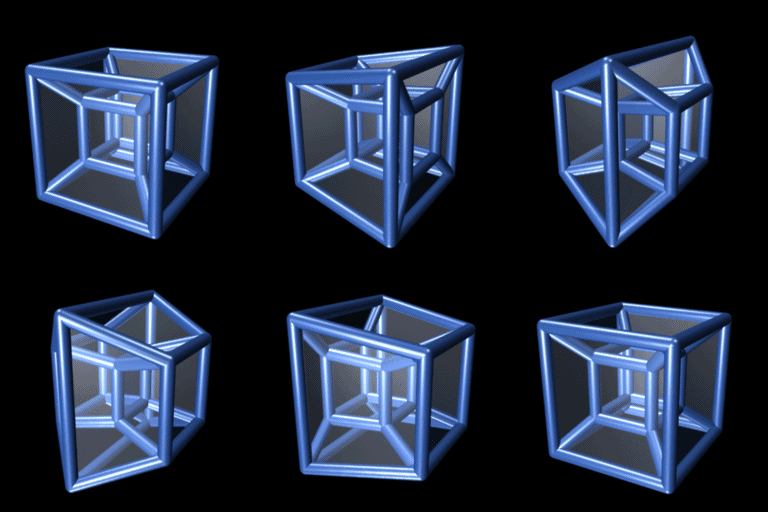
In the book, it is explained that tessering involves moving through the fifth dimension, with the first four dimensions being space and time. This suggests that the fifth dimension is a separate spatial dimension and that, moreover, in the fifth dimension, all points in space are “close” to all other points in space.
The method of travel is further explained as a kind of folding of space. Given that this book was written in 1959-60, that is a fairly impressive early use of Einstein’s theory in science fiction, predating Dune’s famous space folding by five years or so (and being better explained).
Space folding is far-fetched, given the tremendous energy needed to do so, and it seems unlikely that one could accomplish it at will. It would be something like taking the two points on a flat piece of cloth and bringing them close together, which would surely require both time and energy. A simple wormhole from point to point, which would be, for all intents and purposes, the same for the travelers. Yet, even this seems likely not to be accomplished at will between any two points in space. Likely, this would need to be prepared in advance, moving the two ends apart at sub-light speed until they were in position.
Moreover, the idea that all points in space are close to all other points is hard to imagine in an Einsteinian universe where spacetime has a particular shape. If you were to add another dimension, how would you, in fact, make all points close to all other points unless space were terribly compressed in the fifth dimension?
Imagine space as a one-dimensional string. Now, for every point on the string to be close to every other point, it has to be all balled up like a ball of yarn. To travel from one point on the string to another might be a long way if you follow the string along its length, but the two points are always close together as soon as you add a couple more dimensions. If that were the case, surely it would manifest in the other dimensions, as space would have all kinds of twists, turns, and kinks in it.
Clearly, the tessering described in A Wrinkle in Time is a bit more complicated, possible for angels, no doubt, but not for mere mortals.
There is a way, however, that one could travel instantly from one point to another using a fifth dimension that doesn’t involve any folding or curved spacetime at all, no wormholes, and no violating the speed of light. It all depends, however, on what kind of dimension the fifth dimension is.
If the fifth dimension is another dimension of space, as described in the book, then we are stuck with space folding and wormholes.
If the fifth dimension is another dimension of time, however, then it is indeed possible to travel from one point in space to another without violating Einstein’s relativity.
Another dimension of time would enable you to maneuver in time. You could make closed circuits, effectively going back in time, and you could also travel from point to point in one time dimension or the other as much as you want.
At first glance, this doesn’t seem to help you much. After all, while you could travel from Earth to Alpha Centauri instantaneously from the point of view of people here on Earth, you would still have to travel the four light-years, slower than the speed of light. Potentially, time dilation might help you here so that, if you went fast enough, you could eliminate the passage of time both on Earth and for yourself.
There is a cleaner way, however, that might not require such fantastic relativistic speeds, however, depending on whether the fifth dimension has a particular characteristic.
Geometrically, the speed of light limit is an aspect of our light cone. This is a cone that describes where we are allowed to go in space in a given amount of time. Indeed, where anything is allowed to affect anything else.
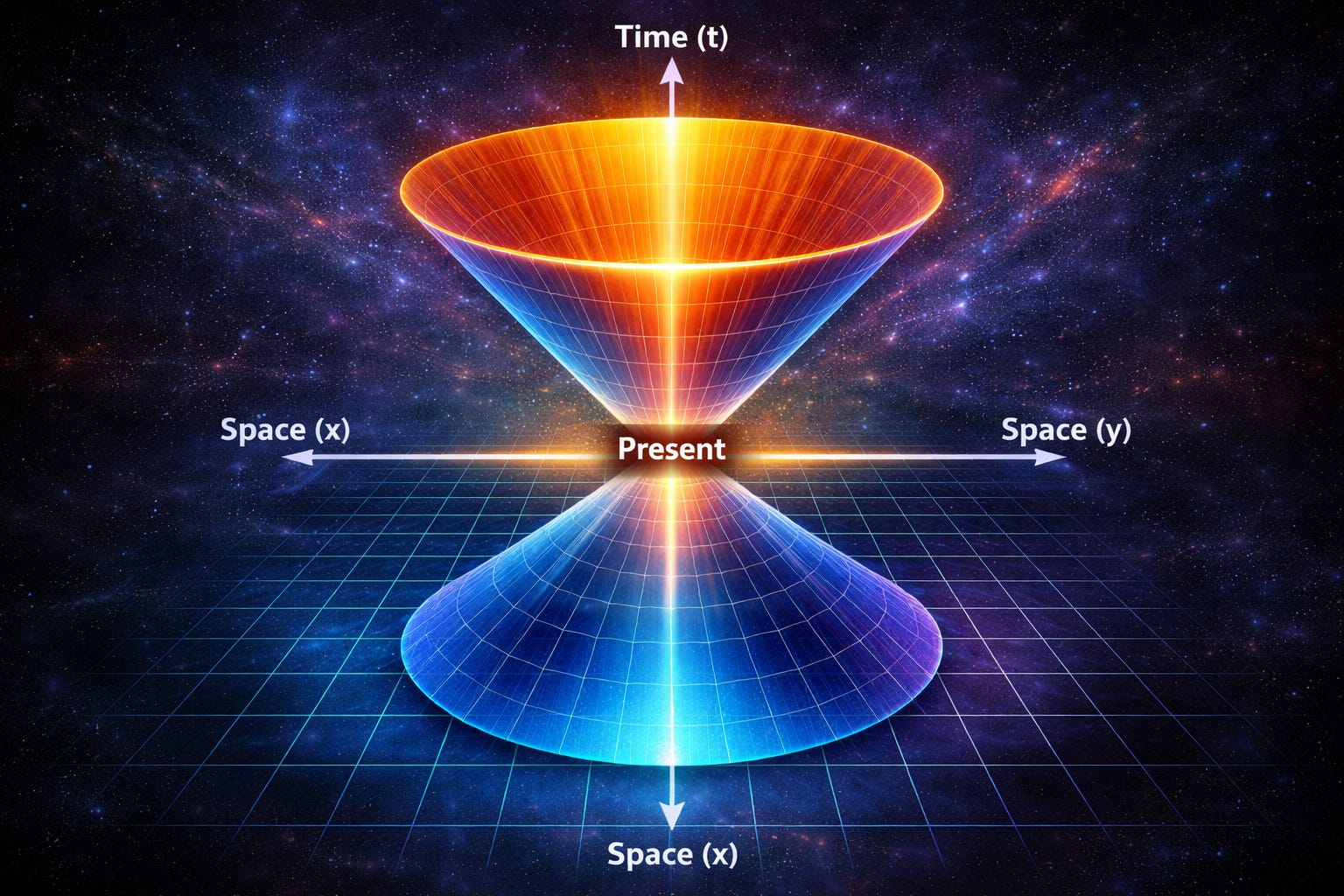
Adding another time dimension just makes the light cone more complicated because it now has two axes within it.
