
Imaginary numbers in quantum mechanics may point to a deeper reality

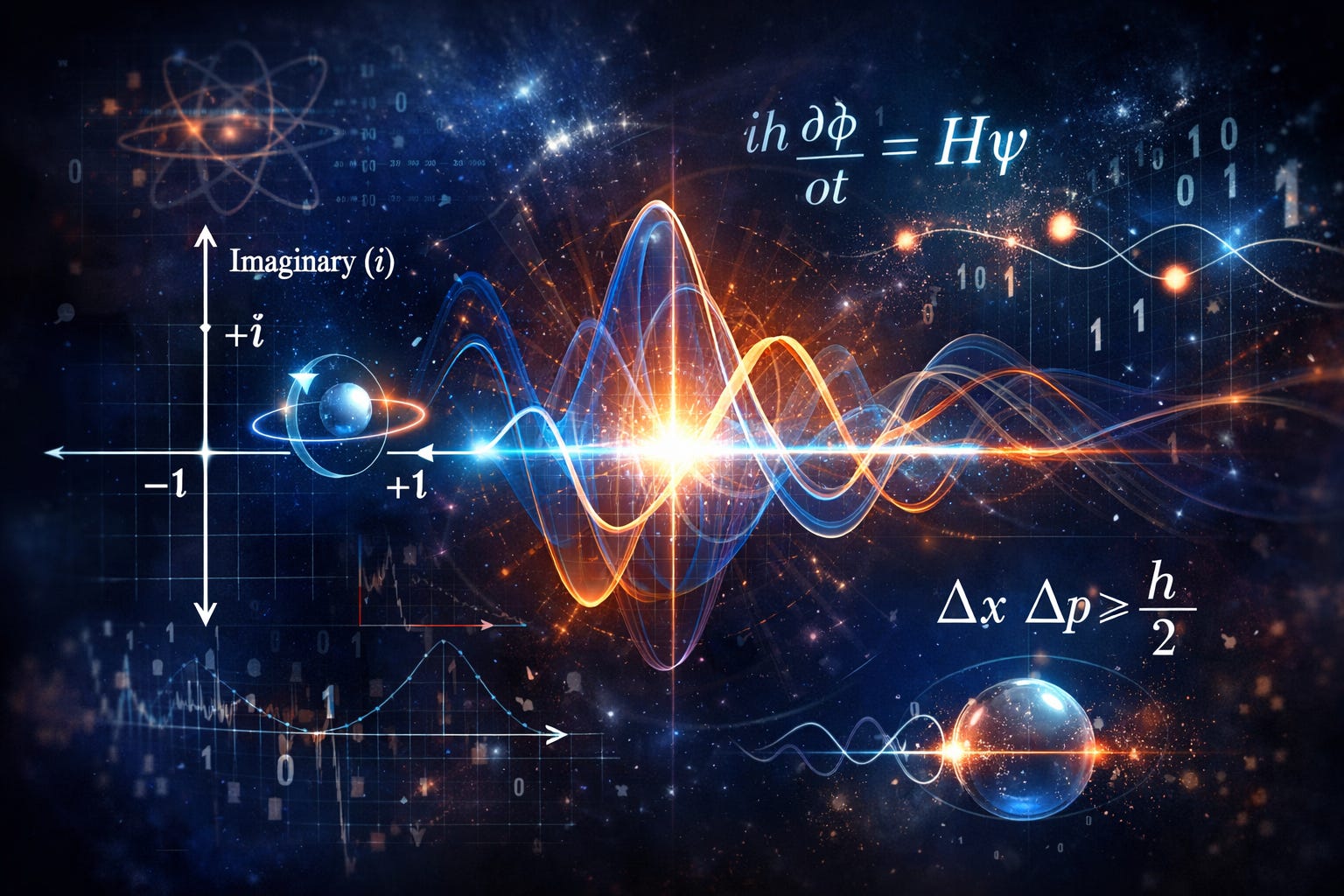
Niels Bohr, one of the fathers of quantum mechanics, upon being confronted with the equations for the new quantum mechanics, argued that they could only be symbolic and not represent anything real. Part of his reasoning was that Schrodinger’s equation equated momentum with an imaginary quantity, meaning a number times the square root of negative one.
Bohr’s opinion is surprising given that in classical electrodynamics, one can represent waves very conveniently as complex numbers, meaning a real number added to an imaginary one. This is because waves, which are solutions to Maxwell’s equations, consist of three quantities in relation to one another: amplitude, frequency, and phase. If you represent a complex number in polar coordinates within the complex plane, the magnitude is the amplitude, while the phase appears as the direction. Frequency is simply how quickly that direction moves in angle as it sweeps around the plane, like a line on a radar screen.
If you want to compare two waves, it is easy to do so by looking at how they move in the complex plane in this way. Thus, one should not be confused by the word “imaginary” when talking about these numbers. They are anything but.
In fact, any kind of digital signal processor will, typically, convert signals it receives into imaginary numbers. It does this by sampling the signal it receives twice for every wavelength. The first sample is the real part, and the second sample is the imaginary. Thus, the physically measurable, an electromagnetic wave, is converted into imaginary numbers.
Was Bohr ignorant of these facts?
Not at all.
